Agentic Trading: What It Is, How It Works, Where To Try It
AI agents have moved from summarizing markets to acting in them. What agentic trading means, how the plumbing works, which platforms support it today, and the controls that make it workable.
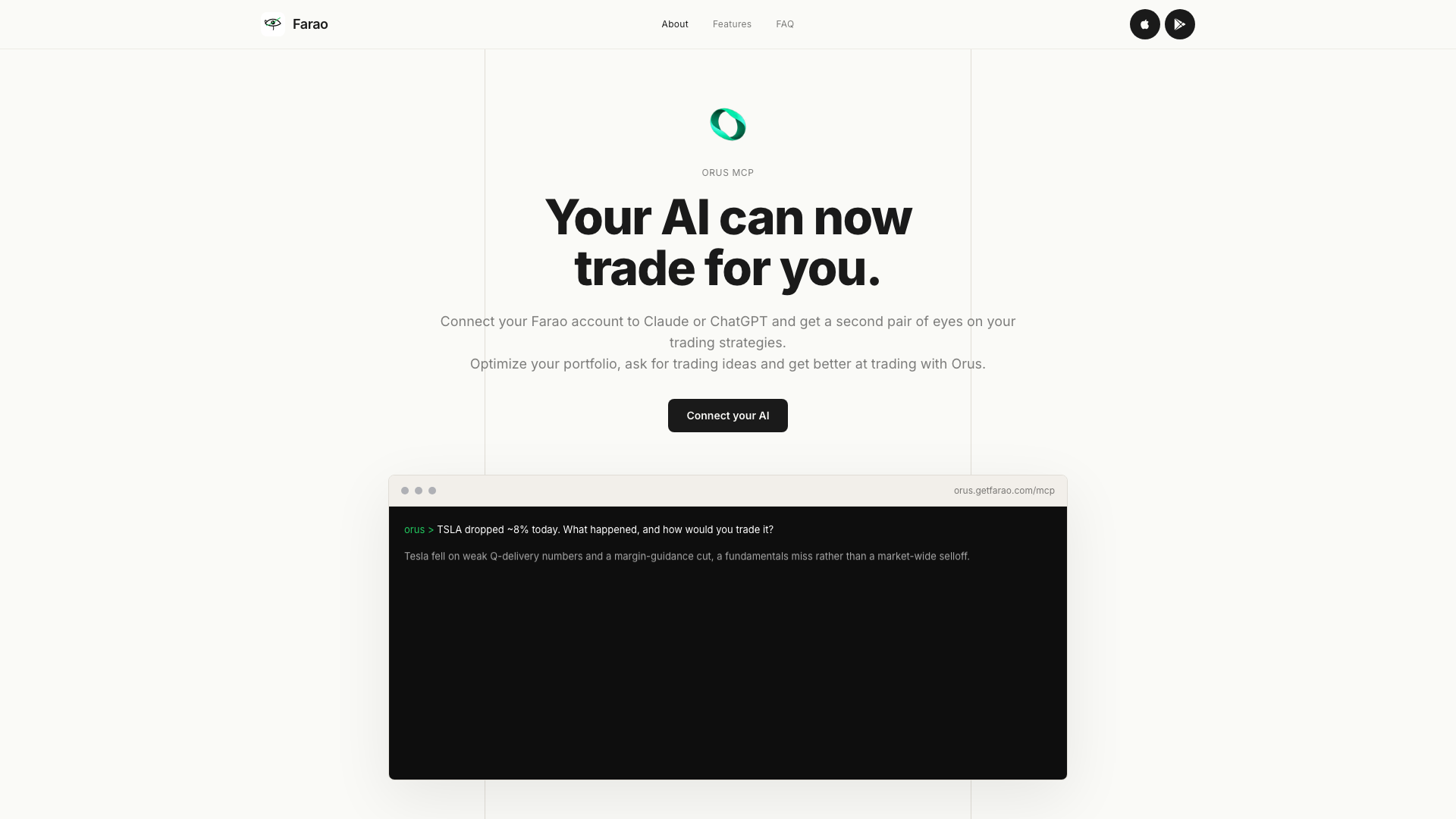
Agentic trading is when an AI agent takes part in the whole trading loop for you: it reads your balances and positions, pulls market data, reasons about what it sees, and prepares or places real orders, all through plain language instead of a trading terminal. The difference from an AI chatbot is execution. An agentic setup gives the agent write access to a real account, under controls you choose.
In 2026 this stopped being a demo. Robinhood opened agentic accounts to its customers, brokers and crypto venues shipped MCP servers, and the question shifted from can an agent trade to under what controls should it. I've been running an agent against a live account for a while now. It is not a money printer and it is not a runaway robot. Done properly, it feels like an extremely fast analyst who can also press the button, but only the buttons you handed over.
What Agentic Trading Means (And What It Isn't)
The term gets stretched, so it helps to separate three things that are often lumped together:
| Trading bot / algo | AI trading assistant | Agentic trading | |
|---|---|---|---|
| Who decides | A fixed strategy you or a vendor coded | You | You set intent and limits, the agent acts inside them |
| Reads your account | Usually, via API keys | No, or read-only | Yes, live |
| Places orders | Yes, automatically | No | Yes, with approval or within caps |
| Adapts to new information | Only if coded to | Gives advice | Reasons about it in plain language |
| Typical example | A grid bot on an exchange | Asking a chatbot about a chart | Telling Claude "close anything paying more than 0.05% funding" |
Agentic finance is the broader version of the same idea, applied to payments, treasury and portfolio operations. Agentic trading is the part where the agent touches orders.
How Agentic Trading Works
The unlock was not a smarter model. It was plumbing. The Model Context Protocol (MCP) gave agents a standard way to connect to external tools. Once trading venues exposed MCP servers, any compatible agent (Claude, ChatGPT, Grok, or an open-source client) could connect to an account the same way it connects to a calendar.
A working setup has four parts:
- The agent. The AI you already talk to, in a chat app, a desktop client or a messaging app.
- The connector. An MCP server run by the venue, which defines the tools the agent can call: read positions, get prices, prepare an order.
- The grant. A permission you approve in the venue's own app, with scopes that decide what the agent may do. This is the trust model: the venue asks you, not the agent.
- The account. Either a dedicated, separately funded sub-account (Robinhood's approach) or a scoped session on your own wallet (Farao's approach).
Before MCP, every "AI trading" product was a closed bot with its own model, its own strategy and your funds on its balance sheet. With MCP, the agent, the connector and the account are separate parts you compose, and you can revoke any one of them without touching the others.
Where You Can Trade With An AI Agent Today
These are the main options in the US as of October 2026. I compare them in depth, including Walnut, Webull and SoFi, in the best agentic trading platforms.
| Platform | What the agent can trade | How it connects | Approval | Custody |
|---|---|---|---|---|
| Robinhood | Long equities, options (single-leg), crypto | Built-in agent or your own via MCP | Optional; off by default for MCP accounts | Custodial, dedicated agentic account |
| Alpaca | Stocks, ETFs, options, crypto | MCP server + API | Whatever you build | Custodial |
| Interactive Brokers | Global multi-asset | API, you build the agent side | Whatever you build | Custodial |
| Public, Webull | US equities | Built-in AI tools | AI assists, you execute | Custodial |
| Farao + Orus | Crypto, tokenized stocks, pre-IPO, indexes, commodities, long or short | MCP from Claude, ChatGPT, Grok, WhatsApp, Telegram | Per session: Manual or Autonomous within caps | Self-custodial, scoped session |
Two things split this table. First, what the agent is allowed to reach: a walled-off funded account, an API key's full scope, or a capped session. Second, who holds the money. Robinhood, Alpaca and IBKR are brokerages that custody your funds. Farao is self-custodial, so the agent trades a wallet you control and has no way to move funds out of it.
What An Agent Can Do With A Trading Account
Connected to a live account, a competent agent handles the work that is tedious for people and trivial for machines:
- Account context on demand. "What's my exposure right now?" returns positions, margin, open orders and recent fills, without app-switching.
- Funding and cost audits. "Which position is costing me the most in funding? Should I close it?" is the kind of cross-referencing agents do better than people.
- Market scans. Prices, funding rates, leverage caps and minimum sizes across hundreds of markets, summarized against your actual positions.
- Order preparation. "Short ETH, 3x, stop above the local high" becomes a structured order with size, leverage and TP/SL, laid out for review before anything executes.
- Position management. Tightening stops, scaling out, closing what hit its thesis: the maintenance that gets skipped when you're busy.
What agents are not good at is conviction. They will build a case for whatever direction you nudge them toward. The honest division of labor in 2026: you own the thesis and the risk appetite, the agent owns the monitoring, the arithmetic and the execution hygiene.
The Architecture That Makes It Safe: Orus As A Worked Example
Agentic trading was a bad idea until recently because the early versions got custody backwards: you gave a bot your API keys or your funds, and hoped. The current pattern inverts that. Orus, the MCP server that connects AI agents to a Farao account, shows what the safe version looks like:
- Keys never reach the agent. Farao is self-custodial and the agent only holds a session token. Private keys stay in secure infrastructure, never in the model's context.
- Absent capabilities, not rules. A connected session can read and trade. It cannot withdraw, transfer, change settings or extend its own permissions, because those tools do not exist in the grant.
- Two modes, chosen at approval. Manual requires your confirmation on every order. Autonomous trades only inside the limits you set (max size per trade, max leverage, a daily cap) and rejects anything above them.
- Full order preview. Before execution you see symbol, direction, size, leverage, margin, entry and liquidation price.
- Revocation and audit. Each session is listed in the app under Settings → Connected apps, with its own PnL, volume and trade count. Revoking one kills its token immediately.
Trades settle on Hyperliquid's onchain order book across 100+ markets, so the agent gets the same market universe as the app.
How To Start Agentic Trading
The setups that last start narrow and widen slowly:
- Pick a platform by its permission model, not its AI. Ask what the agent structurally cannot do. A capped session or a separately funded account beats access to your whole balance.
- Start read-only, or in manual approval mode. Let the agent explain your positions and propose trades for a week before it places any.
- Fund a small slice. Treat the first allocation as tuition. The damage ceiling should be an amount you can lose without changing your plans.
- Write down your rules in plain language. "Never more than 3x. Always set a stop. No new positions after 10pm." Agents follow explicit rules well and vague ones badly.
- Review per-session results. If your platform reports PnL per agent session, compare it with what you would have done yourself.
With Orus, the connection itself is one step. In Claude Code it is claude mcp add --transport http orus https://orus.getfarao.com/mcp. In Claude, ChatGPT or Grok you paste the same URL into the app's connector settings. WhatsApp and Telegram work by messaging Orus directly. Then you approve the session in the Farao app. The Orus docs walk through each client.
What It Feels Like In Practice
The workflows that stick are not "make me money while I sleep." They are narrower and more useful:
The morning check. One message, "anything I should know?", returns overnight PnL, funding paid, positions drifting toward liquidation and stops that no longer make sense. Two minutes instead of fifteen.
The disciplined entry. You bring the idea and the agent brings the checklist. It will not forget the stop-loss, fat-finger the size or skip the funding rate before a swing entry: the mechanical errors that cost real money on a phone at midnight.
The cost audit. Funding is the silent tax on perp positions. An agent that cross-references funding against your holding period catches the position that cost more to carry than it ever moved in your favor.
The guardrailed experiment. With trading allowed but confirmation required, let the agent propose trades for a week and approve only what survives your own judgment. It is a fast way to find out whether its reasoning adds anything to yours.
The Risks, Stated Plainly
Agentic trading inherits every risk of leveraged trading and adds new ones.
- Leverage cuts both ways. Perps and margin can lose more than you expect, fast. A position that moves against you far enough is liquidated, and an agent can open one in seconds.
- Confident and wrong. Fluent reasoning is not good judgment. Models misread data and invent context.
- Prompt injection. An agent that reads the open web and holds trading scopes needs a hard gate between what it reads and your collateral.
- Convenience. Making positions easier to open makes overtrading easier too.
The mitigations are the controls above: the narrowest scopes that work, confirmation or hard caps on every write, small allocations while you build trust, and revoking the moment something feels off. Treat an agent like a new hire on a trading desk: supervised access first, autonomy earned slowly, and never more authority than the damage you can absorb. None of this is investment advice, and no setup guarantees returns.
Frequently Asked Questions
What is agentic trading?
An AI agent taking part directly in the trading loop: reading account state, analyzing markets, and preparing or placing orders through plain language, usually connected to a venue through the Model Context Protocol (MCP).
Is agentic trading the same as algorithmic trading?
No. An algorithm executes a fixed strategy someone coded. An agent takes instructions in plain language, reasons about new information, and acts within the permissions you grant. Many people use both: rules for the strategy, an agent for monitoring and execution.
Can I use ChatGPT or Claude to trade?
Yes, through an MCP connection to a venue that supports it. With Orus you can connect Claude, ChatGPT or Grok to a Farao account, or use WhatsApp and Telegram. Robinhood and Alpaca also accept external agents over MCP.
Can the agent trade without my approval?
Only if you allow it. On Farao, a Manual session needs your confirmation on every order, and an Autonomous session trades only inside the size, leverage and daily caps you set. On Robinhood, trade approvals are a setting, off by default for MCP accounts.
Can an AI agent withdraw my money?
On a well-designed platform, no. Orus sessions have no withdraw or transfer capability at all. Robinhood agents can trade crypto but cannot transfer, stake or lend it. Check this before connecting anything.
Does it cost anything?
Orus is free to connect. Normal trading fees and funding apply to the orders it places, the same as trading in the app.